

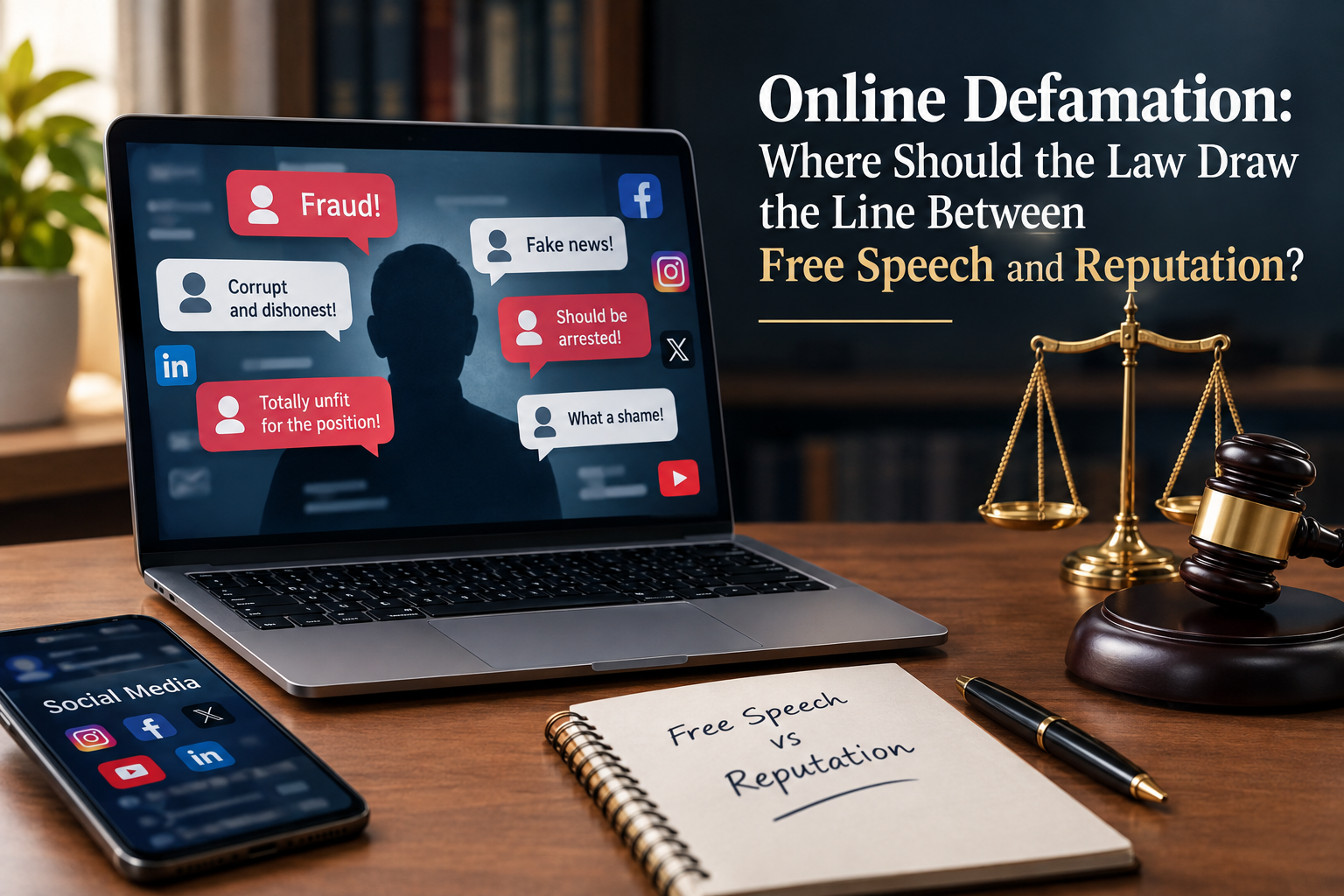
Introduction
The rise of the internet has transformed the way people communicate, share information, express opinions and participate in public discussions. With a smartphone and a social media account, an individual can publish content that may reach thousands or even millions of people within minutes.
While this has strengthened public participation and freedom of expression, it has also created serious concerns regarding the protection of individual reputation. A defamatory statement published online can be shared, reposted, quoted, screenshotted or circulated across multiple platforms. Even after the original content is deleted, copies may continue to exist online.
This creates an important legal question: where should the law draw the line between legitimate freedom of speech and unlawful defamation?
The answer cannot simply be to impose greater restrictions on online speech. Digital platforms are also important spaces for criticism, political discussion, investigative journalism, consumer reviews and public accountability.
The Indian constitutional framework attempts to balance these competing interests. Article 19(1)(a) of the Constitution guarantees freedom of speech and expression, while Article 19(2) permits reasonable restrictions in the interests of defamation, among other grounds.
With the introduction of the Bharatiya Nyaya Sanhita, 2023 (BNS), defamation is now governed primarily by Section 356. The provision applies to imputations made through different forms of communication, including modern digital forms of publication.
The central issue, therefore, is not whether freedom of speech or reputation should prevail absolutely but how the law should protect both constitutional values.
What Is Online Defamation in India?
Indian law does not create a separate offence specifically called “online defamation.” Instead the general law of defamation applies when defamatory material is published through digital platforms.
Social media posts, online articles, comments, videos, websites and other forms of digital communication may potentially attract defamation law if the necessary legal ingredients are established.
Section 356 of the Bharatiya Nyaya Sanhita, 2023 deals with defamation and covers imputations made through words, signs, visual representations or other forms of communication.
The provision also recognises several statutory exceptions, including circumstances involving:
- Truth where publication is for the public good
- Good-faith opinions concerning public servants
- Good-faith opinions regarding public questions
- Substantially true reports of court proceedings
- Fair and honest expression regarding matters already decided by courts
- Complaints made in good faith to a person having lawful authority
- Communications made in good faith for the protection of one’s interests or another person’s interests
These exceptions are important because criticism of a public official, business, institution or public policy should not automatically become defamation merely because the subject of the criticism finds it unpleasant or damaging.
Freedom of Speech and the Right to Reputation
Freedom of speech is a fundamental constitutional right under Article 19(1)(a) of the Constitution of India. It protects the ability of citizens to express ideas, opinions, information, criticism and views on matters of public importance.
At the same time, Article 19(2) expressly recognises defamation as a permissible ground for imposing reasonable restrictions on this freedom.
The Supreme Court has also recognised reputation as an important aspect of individual dignity.
In Subramanian Swamy v. Union of India, the Supreme Court upheld the constitutional validity of criminal defamation and recognised that the protection of reputation and freedom of speech must coexist.
Therefore, freedom of speech does not provide an unrestricted right to make knowingly false and damaging allegations against another person. At the same time, protection of reputation cannot mean that individuals, businesses, politicians or public officials are immune from criticism.
The distinction between legitimate criticism and reputational harm is therefore central to defamation law.
When Does Criticism Become Defamation?
One of the most important distinctions in defamation law is the difference between an opinion and an assertion of fact.
For example, saying:
“I believe this lawyer handled the case poorly.”
may generally be understood as an expression of opinion.
However, stating:
“This lawyer took money from the opposing party.”
is a factual allegation that may carry serious implications for the person’s professional reputation.
The wording of a statement alone, however, may not always determine its legal character. Courts may consider the substance, context, meaning and overall effect of the publication.
Similarly, describing a politician as “incompetent” may fall within political criticism, whereas falsely accusing the politician of accepting a bribe may constitute a substantially different type of allegation.
The protection given to good-faith opinion is particularly important in a constitutional democracy. Public debate often involves strong, uncomfortable or unpopular criticism. The law should not discourage legitimate discussion merely because the criticism is harsh.
However, freedom of opinion cannot become a protection for knowingly false factual allegations made with the intention of damaging another person’s reputation.
The Internet Has Changed the Scale of Reputational Harm
Traditional forms of publication had certain practical limitations. A newspaper had a particular circulation, while a statement made privately could reach only a limited number of people.
Digital communication has fundamentally changed this situation.
A single defamatory post can:
- Reach a large audience within minutes
- Be repeatedly shared across platforms
- Appear in search-engine results
- Be preserved through screenshots
- Be reproduced even after deletion
- Be taken out of its original context
- Become amplified by social-media algorithms
This can make reputational damage significantly more difficult to control.
An individual falsely accused of criminal conduct, professional misconduct, theft or other serious wrongdoing may find it difficult to ensure that a later correction receives the same level of attention as the original allegation.
However, the greater potential for harm online does not justify removing constitutional protections applicable to digital speech.
Online platforms remain important spaces for public debate, journalism, criticism and accountability.
Why Public Figures Must Still Face Criticism
Politicians, public officials and other public figures are naturally subject to greater public scrutiny.
A democratic society cannot require criticism of public figures to be expressed only in a manner that is comfortable or favourable to them.
Section 356 of the BNS recognises protections for good-faith opinions concerning public servants and matters of public concern. This reflects the principle that public accountability requires room for criticism.
At the same time, public status does not eliminate the right to reputation.
A politician or public official may legitimately seek legal remedies where a person knowingly publishes a false allegation of criminal or disgraceful conduct.
The law must therefore distinguish between:
- Legitimate criticism of public conduct
- Political disagreement
- Satire and commentary
- Good-faith opinion
- Knowingly false allegations presented as facts
This distinction is particularly important because the threat of legal proceedings itself may discourage ordinary citizens from participating in public debate.
The Problem of Anonymous Social-Media Accounts
Online anonymity presents another challenge for defamation law.
Anonymous communication can serve legitimate democratic purposes. Whistle-blowers, political dissidents and individuals reporting wrongdoing may sometimes require anonymity to protect themselves from retaliation.
However, anonymity can also be misused to publish fabricated allegations, impersonate others or engage in persistent harassment.
An anonymous account should therefore not automatically provide immunity from legal consequences where the content otherwise falls within the scope of defamation law.
At the same time, safeguards are necessary before revealing the identity of an anonymous speaker, particularly where the speech may have legitimate constitutional protection.
The legal challenge lies in balancing:
- Freedom of anonymous expression
- Privacy
- Protection against unlawful speech
- The right to reputation
- Accountability of online users
Social-Media Platforms and Intermediary Liability
Online defamation also raises questions regarding the responsibility of social-media platforms and other intermediaries.
Platforms may host enormous amounts of user-generated content, making it impractical for them to independently verify every statement published by every user.
Indian law provides intermediaries with conditional protection through Section 79 of the Information Technology Act, 2000, subject to applicable requirements and due diligence obligations.
The Information Technology (Intermediary Guidelines and Digital Media Ethics Code) Rules, 2021 also impose additional due-diligence requirements on intermediaries.
The legal framework therefore seeks to distinguish between the person who creates and publishes unlawful content and the intermediary that provides the platform through which that content is distributed.
The objective is to maintain an appropriate balance between intermediary protection and effective mechanisms for addressing unlawful online content.
Shreya Singhal and the Danger of Vague Online-Speech Restrictions
The Supreme Court’s decision in Shreya Singhal v. Union of India is significant when considering restrictions on online speech.
The Court struck down Section 66A of the Information Technology Act because of the vague and overbroad nature of the restrictions it imposed on online expression.
Although the case did not directly concern defamation, its constitutional reasoning is relevant to the regulation of online speech.
A legal system should not make citizens uncertain about whether criticism is lawful merely because someone finds the expression offensive, insulting or unpleasant.
A negative review, political cartoon, criticism of a public official or unpopular opinion should not automatically be treated as defamatory.
The legal focus must instead remain on whether the statement satisfies the requirements of defamation law.
Criminal Defamation: Is the Law Too Harsh?
Section 356(2) of the Bharatiya Nyaya Sanhita provides punishment for defamation that may include simple imprisonment for a term extending up to two years, fine, both or community service.
The criminal nature of defamation raises important constitutional and procedural concerns.
Criminal proceedings can impose significant financial, practical and emotional burdens on an accused person, even before the final determination of guilt.
This concern becomes particularly relevant where the person facing proceedings is an ordinary citizen who has criticised a powerful individual or institution.
At the same time, the Supreme Court in Subramanian Swamy v. Union of India upheld the constitutional validity of criminal defamation.
The procedural safeguards surrounding prosecution are therefore important. Section 222 of the Bharatiya Nagarik Suraksha Sanhita, 2023 provides that a court generally cannot take cognisance of an offence under Section 356 except upon a complaint made by the person aggrieved by the offence.
The objective is to prevent defamation law from becoming a general-purpose criminal provision that can be invoked by anyone merely because they dislike a particular statement.
Truth, Good Faith and Public Interest
Defamation law does not treat every injury to reputation as unlawful.
The law recognises circumstances where publication may be protected because of truth, public interest, good faith or other statutory exceptions.
For example, publication of verified information concerning matters of genuine public importance may cause reputational harm to the person concerned. However, where the law recognises the publication as falling within an applicable exception, the resulting reputational harm does not automatically make the publication defamatory.
Good-faith communication for the protection of one’s own interests or another person’s interests may also receive statutory protection.
These principles are particularly significant for journalists, researchers, whistle-blowers, citizens and others participating in public discourse.
The Difference Between Being Offended and Being Defamed
Being offended by a statement is not necessarily the same as being defamed.
Online communication frequently contains:
- Sarcasm
- Humour
- Satire
- Strong opinions
- Harsh criticism
- Political commentary
- Negative reviews
Not every unpleasant statement can or should become a defamation claim.
For instance, describing a politician as “the worst politician in the country” may ordinarily represent an opinion, while falsely stating that the same politician “stole public funds” presents a specific factual allegation.
The distinction may not always be straightforward and courts must examine the statement in its complete context.
The central question is whether the publication amounts to an actionable imputation that harms or is intended or known to harm the reputation of the person concerned, subject to the statutory exceptions.
Where Should the Law Draw the Line?
The line between protected expression and defamation must be drawn by examining the substance and circumstances of the communication rather than merely its form.
Relevant considerations may include:
- Whether the statement is fact or opinion
- Whether the statement is true
- Whether it was made in good faith
- Whether it concerns a matter of public interest
- The identity of the person concerned
- The circumstances in which it was published
- The meaning conveyed to an ordinary reader
- Whether the publication falls within a statutory exception
A satirical post about a politician should not automatically be treated in the same manner as a fabricated allegation of corruption.
Similarly a genuine negative consumer review should not automatically amount to criminal defamation merely because a business dislikes the review.
At the same time a person cannot simply invoke “freedom of speech” as a defence for deliberately creating and distributing fabricated allegations with the purpose of damaging another person’s reputation.
Proportionality is also important. Depending on the circumstances, correction, removal, retraction or civil remedies may sometimes be more appropriate than criminal prosecution.
Conclusion
Online defamation presents a complex constitutional challenge because it requires the law to balance two important interests: freedom of speech and the protection of reputation.
The Indian constitutional framework already recognises both interests. Article 19(1)(a) protects freedom of speech and expression, while Article 19(2) permits reasonable restrictions in the interests of defamation.
Section 356 of the Bharatiya Nyaya Sanhita, 2023 provides the current statutory framework for criminal defamation and recognises several exceptions protecting truthful, good-faith and legitimate forms of expression.
The Supreme Court’s decisions in Subramanian Swamy v. Union of India and Shreya Singhal v. Union of India demonstrate the importance of maintaining this constitutional balance.
The objective should not be to make online spaces free from criticism, disagreement, satire or uncomfortable opinions. At the same time, digital platforms should not become spaces where knowingly false and damaging allegations can be published without legal consequences.
The appropriate legal boundary lies where legitimate expression crosses into wrongful and unjustified injury to reputation, while continuing to protect democratic debate, criticism, journalism and public accountability.
Frequently Asked Questions (FAQs)
What is online defamation in India?
Online defamation refers to defamatory statements or imputations communicated through the internet, including social-media posts, websites, online videos, comments and digital publications. Indian law does not create a separate offence called “online defamation”; such conduct may fall within Section 356 of the Bharatiya Nyaya Sanhita, 2023.
Is online defamation a criminal offence in India?
Yes. Defamation is a criminal offence under Section 356 of the Bharatiya Nyaya Sanhita, 2023. Section 356(2) provides for simple imprisonment of up to two years, fine, both or community service, subject to the applicable legal requirements and exceptions.
Can a person be sued for a social-media post?
A social-media post may attract defamation proceedings if it satisfies the legal requirements of Section 356 and does not fall within an applicable statutory exception. The exact legal position depends on the wording, context, circumstances and nature of the publication.
Is criticism of a politician defamation?
Not necessarily. Good-faith opinions concerning the conduct of public servants and matters of public concern may receive statutory protection. However, knowingly false and damaging factual allegations may potentially attract defamation law.
Can a negative review be considered defamation?
A negative review is not automatically defamatory. Genuine criticism and opinions about a product or service may be protected. However, a knowingly false factual allegation that harms or is likely to harm the reputation of a person or business may raise defamation concerns.
What is the punishment for online defamation under the BNS?
Under Section 356(2) of the Bharatiya Nyaya Sanhita, 2023, defamation may be punishable with simple imprisonment for up to two years, fine, both or community service.
Can a person remain anonymous online and avoid defamation liability?
Anonymity does not necessarily provide immunity from legal liability. However, because anonymous speech may have legitimate constitutional value, appropriate safeguards may be required before the identity of an anonymous speaker is disclosed.
Can social-media platforms be held responsible for defamatory posts?
Intermediaries may receive conditional protection under Section 79 of the Information Technology Act, 2000, subject to applicable legal requirements and due-diligence obligations. The specific liability of a platform depends on the circumstances and applicable law.
What is the difference between defamation and criticism?
Criticism generally expresses an opinion or evaluation, whereas defamation involves an actionable imputation concerning a person that harms or is intended or known to harm reputation, subject to statutory exceptions. The context and substance of the communication are important in determining the distinction.
References
- Constitution of India, Articles 19(1)(a), 19(2) and 21.
- Bharatiya Nyaya Sanhita, 2023, Section 356 — Defamation.
- Bharatiya Nagarik Suraksha Sanhita, 2023, Section 222 — Prosecution for defamation.
- Information Technology Act, 2000, Section 79 — Intermediary safe harbour.
- Information Technology (Intermediary Guidelines and Digital Media Ethics Code) Rules, 2021.
- Subramanian Swamy v. Union of India, (2016) 7 SCC 221.
- Shreya Singhal v. Union of India, (2015) 5 SCC 1.
- R. Rajagopal v. State of Tamil Nadu, (1994) 6 SCC 632.
- S. Khushboo v. Kanniammal, (2010) 5 SCC 600.
- D.C.S. Wariar v. Union of India, 2025 INSC 441.
- Law Commission of India, 246th Report on Amendments to the Arbitration and Conciliation Act, 1996.
- Ministry of Electronics and Information Technology, Government of India, Information Technology (Intermediary Guidelines and Digital Media Ethics Code) Rules, 2021.
- Ministry of Law and Justice, Government of India, Bharatiya Nyaya Sanhita, 2023 and Bharatiya Nagarik Suraksha Sanhita, 2023.