

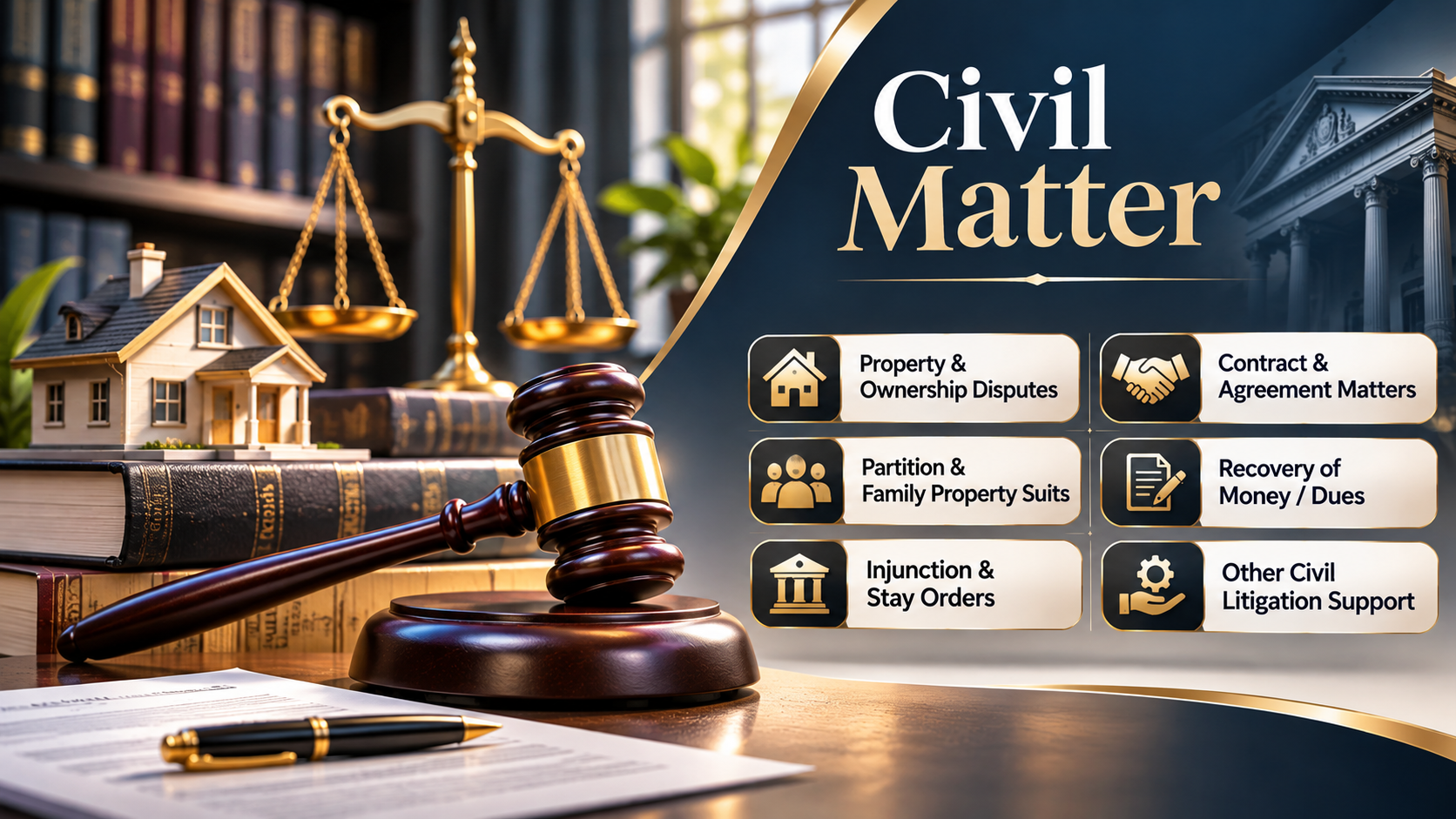
Tanwar & Associates provides legal representation in civil matters, assisting individuals, families, businesses and organisations with civil disputes through legal consultation, case assessment, documentation and court representation. The firm handles civil litigation matters involving property claims, recovery proceedings, contractual disputes, injunctions and other civil remedies.
Civil matters are legal disputes involving private rights and obligations between individuals, companies, organisations or other parties. Unlike criminal proceedings, which primarily deal with offences and punishment, civil cases generally seek remedies such as compensation, recovery of money, enforcement of contractual rights, declaration of legal status or protection through court orders.
The Code of Civil Procedure, 1908 (CPC) provides the primary procedural framework for civil suits in India. The substantive law applicable to a dispute depends on its nature and may involve contract law, property law, succession law or other relevant legislation.
Civil disputes may be resolved through court litigation or, where appropriate, alternative dispute resolution methods such as negotiation, mediation and arbitration.
Common Types of Civil Matters
Civil litigation covers different categories of legal disputes. Identifying the nature of the issue helps determine the appropriate legal remedy and proceedings.
1. Property Disputes
Property disputes may arise over ownership, possession, title, boundaries, transfer of property or competing claims between parties. These matters can involve residential properties, commercial premises, land or jointly owned assets.
Depending on the circumstances, legal remedies may include declaration of ownership, partition, recovery of possession or an injunction to protect property rights.
2. Contractual Disputes
Contractual disputes arise when one party fails to fulfil an obligation under a legally enforceable agreement. Such matters may involve business contracts, service agreements, construction arrangements, partnership agreements or sale agreements.
A party affected by a contractual breach may seek damages, specific performance, cancellation or another remedy available under applicable law.
3. Money Recovery Cases
Money recovery proceedings may become necessary when a borrower, customer, business partner or another party fails to repay an outstanding amount.
The appropriate legal approach depends on the nature of the transaction, supporting documents, limitation period and applicable procedure. Agreements, invoices, payment receipts, bank statements and written communications may serve as important evidence.
4. Partition and Property Share Disputes
Disagreements concerning ancestral property, inherited assets or jointly owned property can lead to partition disputes.
A person with a legally recognised share may seek an appropriate division of property through mutual settlement or court proceedings. The rights of the parties depend on ownership records, succession laws, family arrangements and other relevant facts.
5. Injunction and Stay Order Matters
An injunction is a judicial remedy that may restrain a party from performing a particular act or, in certain circumstances, require an act to be performed.
Such relief may be relevant when someone threatens to interfere with possession, carry out unauthorised construction, transfer disputed property or otherwise affect another party’s legal rights.
Courts consider the applicable legal requirements and supporting evidence before granting temporary or permanent injunctions.
6. Declaration Suits
A declaration suit may be filed when a person seeks a formal judicial declaration regarding an existing legal status or right.
These cases may concern ownership, property interests, contractual rights or other legal relationships. The relief sought depends on the nature of the dispute and the requirements of the Specific Relief Act, 1963.
7. Landlord-Tenant Disputes
Landlord-tenant disputes may involve non-payment of rent, possession, tenancy agreements, eviction, property maintenance or disagreements regarding contractual obligations.
The applicable legal procedure depends on the type of tenancy, the location of the property and relevant rent-control or property laws.
8. Specific Performance Matters
Specific performance is a legal remedy through which a court may direct a party to fulfil contractual obligations where the requirements of the Specific Relief Act are satisfied.
Such proceedings may arise in property transactions, sale agreements and other contractual disputes where monetary compensation may not provide an adequate remedy.
9. Damages and Compensation Claims
A person who suffers a legally recognised loss due to another party’s breach of obligation or wrongful conduct may be entitled to seek compensation or damages.
The availability and extent of relief depend on the legal basis of the claim, evidence of loss and applicable statutory provisions.
Important Laws Governing Civil Matters in India
Different statutes govern civil disputes depending on the subject matter and relief involved. Some important laws include:
-
Code of Civil Procedure, 1908: Provides the procedural framework for civil suits, pleadings, hearings, appeals and execution of decrees.
-
Indian Contract Act, 1872: Governs contractual obligations, agreements, breach of contract and related remedies.
-
Specific Relief Act, 1963: Provides remedies such as specific performance, injunctions and declaratory relief.
-
Transfer of Property Act, 1882: Deals with property transfers and related legal rights.
-
Limitation Act, 1963: Prescribes limitation periods for different types of legal proceedings.
-
Registration Act, 1908: Regulates the registration of specified documents and transactions.
The applicable provisions depend on the facts of the dispute, the parties involved and the remedy being sought.
How Does the Civil Litigation Process Work?
Civil litigation follows an established legal procedure. The exact stages may differ depending on the type of case, court jurisdiction and applicable laws.
1. Initial Consultation and Case Assessment
The first step is to understand the dispute, identify the parties involved and assess the legal rights affected. A lawyer can examine the circumstances and explain the available legal remedies.
2. Document Review and Legal Research
Relevant agreements, property records, payment receipts, notices, correspondence and other supporting documents are reviewed. This helps establish the factual background and identify the legal issues involved.
3. Drafting and Filing of the Civil Suit
When court proceedings are necessary, a plaint is prepared containing the relevant facts, legal grounds and relief sought. The suit must be filed before the appropriate court in accordance with jurisdictional and procedural requirements.
4. Summons and Written Statement
After the court directs service of summons, the defendant receives an opportunity to respond to the allegations by filing a written statement within the applicable period.
5. Framing of Issues and Evidence
The court identifies the disputed questions that require determination. Both parties may present documentary and oral evidence, examine witnesses and respond to the opposing party’s evidence.
6. Final Arguments and Judgment
After the evidence stage, the parties present their legal arguments. The court considers the pleadings, evidence and applicable law before delivering its judgment.
7. Appeals and Execution Proceedings
Where the law permits, an aggrieved party may challenge the judgment through an appeal. If a decree is passed, the successful party may initiate execution proceedings to enforce it under the applicable provisions of the CPC.
Why Is Professional Legal Representation Important in Civil Matters?
Civil disputes can involve complicated documentation, procedural requirements and questions of law. Proper legal guidance helps parties understand their rights and take appropriate steps.
A civil lawyer can assist with:
-
Assessing the facts and identifying available legal remedies.
-
Understanding court jurisdiction and limitation requirements.
-
Drafting plaints, written statements and legal applications.
-
Reviewing contracts and property-related documents.
-
Preparing and presenting documentary and oral evidence.
-
Seeking interim injunctions and stay orders where legally justified.
-
Representing clients during civil court hearings and trials.
-
Advising on settlement, negotiation and mediation.
-
Handling appeals and execution proceedings.
A carefully prepared legal strategy can help avoid procedural mistakes and ensure that relevant facts and documents are properly presented before the court.
Documents Required for Civil Court Proceedings
The documents required depend on the nature of the dispute. Commonly relevant records may include:
-
Identity and address proof of the parties.
-
Agreements, contracts and legal documents.
-
Property ownership and registration records.
-
Sale deeds, title documents and possession records.
-
Bank statements, invoices and payment receipts.
-
Legal notices and replies.
-
Emails, letters and other written communications.
-
Photographs, reports and supporting evidence.
-
Previous court orders or case records, where applicable.
Keeping these documents organised can make case assessment and preparation of legal proceedings more efficient.
Civil Legal Services at Tanwar & Associates
Civil litigation requires an understanding of the facts, applicable legislation and procedural requirements. Tanwar & Associates provides legal assistance across a range of civil disputes, with attention to the specific circumstances and objectives of each client.
The firm’s civil litigation services include:
-
Legal consultation and case assessment.
-
Drafting and filing of civil suits.
-
Injunction applications and stay orders.
-
Recovery proceedings.
-
Declaration suits.
-
Specific performance matters.
-
Contractual disputes.
-
Property-related claims.
-
Partition disputes.
-
Landlord-tenant disputes.
-
Appeals and execution proceedings.
-
Settlement and negotiation assistance.
The firm also provides representation before Civil Courts and High Courts, depending on the nature of the matter and applicable jurisdiction.
Trusted Legal Support
Whether you are dealing with a property disagreement, contractual issue, financial claim or another civil dispute, obtaining timely legal guidance can help clarify your options and determine the appropriate course of action.
When Should You Consult a Civil Lawyer?
You should consider consulting a civil lawyer when:
-
Someone challenges your ownership or possession of property.
-
A contractual obligation has not been fulfilled.
-
You need to recover outstanding payments or money.
-
You are involved in a partition or inheritance dispute.
-
Another party interferes with your legal rights.
-
You receive a legal notice or court summons.
-
You need to file a civil suit or defend an existing case.
-
You require an injunction to prevent potential harm to your legal interests.
Seeking legal advice at an early stage can help identify limitation issues, preserve relevant evidence and select an appropriate legal remedy.
Frequently Asked Questions (FAQs)
1. What are civil matters in Indian law?
Civil matters involve disputes concerning private legal rights and obligations. Common examples include property disputes, money recovery, breach of contract, inheritance, possession and compensation claims.
2. Which law governs civil cases in India?
The Code of Civil Procedure, 1908, provides the primary procedural framework for ordinary civil suits. The substantive rights and remedies may be governed by other laws, depending on the nature of the dispute.
3. Can I file a civil case for a property dispute?
Yes. Depending on the circumstances, a person may approach the competent civil court for remedies such as declaration of ownership, partition, recovery of possession or an injunction.
4. How long does a civil case take to resolve?
The duration depends on the complexity of the dispute, court workload, evidence, procedural applications and other circumstances. Some matters may be resolved relatively quickly, while others can take several years.
5. Can a civil dispute be resolved without going to court?
Yes. Depending on the nature of the dispute, parties may explore negotiation, mediation, conciliation or arbitration where legally appropriate. An agreed settlement may help avoid lengthy litigation.
6. Is there a time limit for filing a civil suit?
Yes. The Limitation Act, 1963, prescribes different limitation periods for different types of claims. The applicable period depends on the cause of action and relevant legal provisions.
7. What happens if someone does not follow a civil court decree?
The successful party may seek enforcement through execution proceedings under the applicable provisions of the CPC. The available execution method depends on the nature of the decree.
8. Why should I consult Tanwar & Associates for a civil dispute?
Tanwar & Associates offers legal assistance in civil litigation, including property disputes, recovery proceedings, injunctions, contractual matters, declaration suits and appeals. The appropriate legal approach depends on the facts and requirements of each case.
Conclusion
Civil disputes can affect property, finances, contractual relationships and important legal rights. Understanding the applicable laws, maintaining proper documentation and choosing the correct legal remedy are essential steps towards resolving such matters.
Tanwar & Associates provides legal consultation and representation across various civil litigation matters, including property disputes, recovery suits, injunctions, contractual issues and other civil proceedings. If you are facing a civil dispute, seeking professional legal advice can help you understand your rights and make informed decisions about the way forward.
Contact Tanwar & Associates
-
Address: WZ 44H, Possangipur, Janakpuri, Delhi – 110058
-
Phone: +91 99100 69275
-
Email: tanwar_associates@yahoo.com
-
Website: https://tanwarandassociates.com/